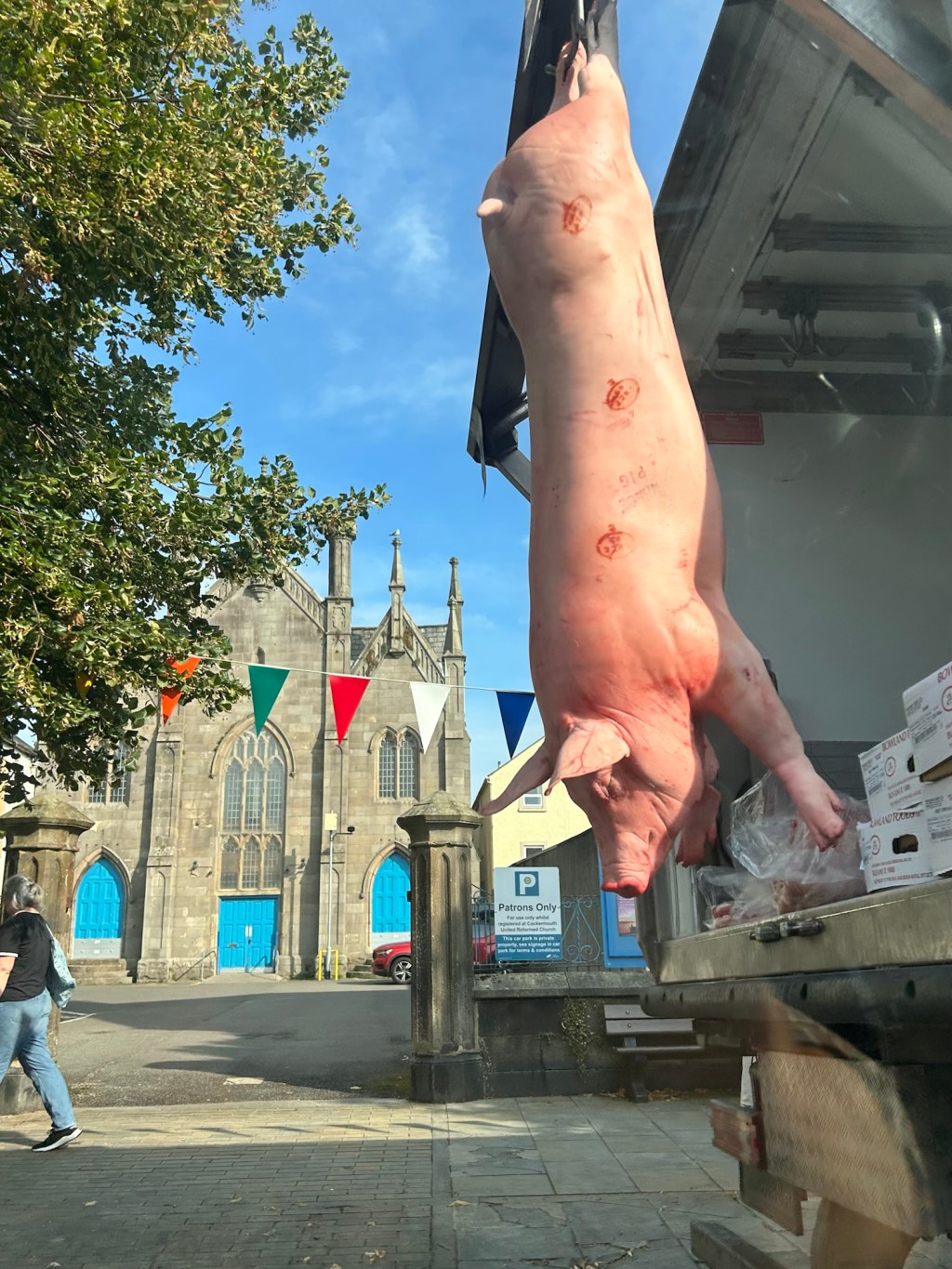
Once, while driving through the centre of Cockermouth, we drove past a butcher’s van. Hanging from a hook on the back door of the van was a full pig’s carcass. Unpracticed at seeing full bodies suspended in real time on a busy highstreet, we stared while still driving. This did lead to us missing our turning which meant we had to do a drive round the town again. On the second time round, there it was still strung up just swaying slightly with the movements of the workers unloading the van. The way it just swayed lifeless but still with a hint of animality was uncanny.
We live in a world that has become so sanitised that we do not see the food we eat as a post-living thing. We see all our food as packaged and marketed items that are ready for our tables. Through butchery and careful marketing, animals become “absent referents.”1 The meat we eat very rarely looks like the animal it came from. Very rarely do we look at our steak on a plate and say “mmm cow!” or the slices of bacon in our sandwich and think “mmm pig!” That pig hanging from the butcher’s van is no longer there, it has been transformed into a multitude of different pork products. The animal has been gladly salted, chopped and packaged away.2 We butcher away the concept of an animal and instead leave a sanitised food item rather than a living thing.
Even in the names we call meat, we clean away the animal. The object changes its name as it enters a market or kitchen. Pigs are no longer animals they become pork. Cows become beef.
Interestingly, this change in name comes from the Norman conquest of England and refers more to the class of people farming animals and to the people consuming meat. Thus the names of the animals in the field come from the Anglo-Saxons who worked the land and raised the animals, and the names of the meat came from the Norman aristocracy who consumed the meat. As Walter Scott suggests, “a Saxon swine turns into Norman pork.” 3 Pig – porc – pork. Cow – boef – beef. This linguistic gap again creates an absence of the animal on our plates. The linguistic history of English has given most animals two identities that of the animal in the field and that of the meat on our plates. By doing this we sanitise the life (and ordinarily the death) away and prevent the food from being perceived as something that “was once an animal.”4
In my journey to meat eating, I said to myself that I would hold the life of the animal within the food on our plates. We should know where our food comes from and “for every bit of meat you eat, there is something killed for it.”5 Recently, we visited Clarkson’s Farm and loved the fact that when ordering a steak and lager pasty, we could see the name of the farm that the beef came from. We were not just looking at a chunk of meat, we were looking at a chunk of meat that came from cows raised by a specific farmer.
I said to myself, let’s see this meal for what it really is: an animal. There is more respect in that than simply eating a piece of meat we have unwrapped from plastic and thrown in the oven. If we are going to eat meat, let’s see the animal with its face, ears and eyes, rather than deliberately looking away from the animal on our plates.
- Carol J. Adams, The Sexual Politics of Meat (1990) ↩︎
- John Berger — “Why Look at Animals?” (1980) ↩︎
- Walter Scott, Ivanhoe (1819) This comment on the names of animals is also an interesting commentary on class aswell as the sanitisation of the animal from our plates. ↩︎
- Carol J. Adams, The Sexual Politics of Meat (1990) ↩︎
- Hugh Fearnley-Whittingstall, interviewed by Marissa Rothkopf Bates in ‘River Cottage Goes Vegetarian’, https://www.publishersweekly.com/pw/by-topic/industry-news/cooking/article/57283-river-cottage-goes-vegetarian.html?utm_source=chatgpt.com ↩︎


Leave a Reply